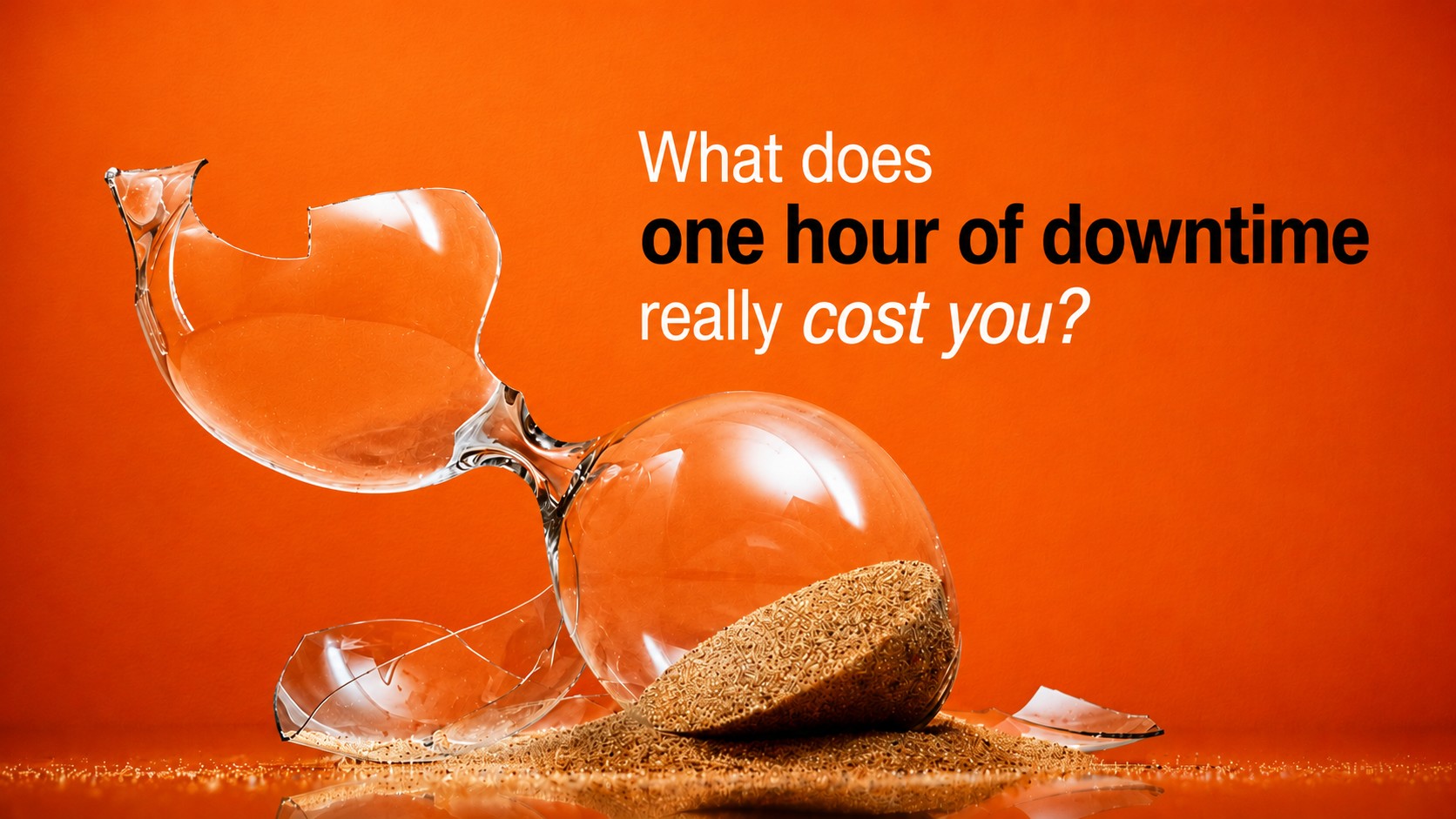
If your business lost access to its systems for just one hour tomorrow, would you know what it would cost?
Most business owners can estimate lost sales. Fewer consider the cost of employees waiting to work, delayed customer responses, missed opportunities, or the time required to recover after systems are restored. The truth is that downtime is rarely just an IT problem — it becomes a business problem almost immediately.
As we reach the midpoint of the year, it's a good time to take a fresh look at one of the most overlooked risks affecting growing organizations: the true cost of business interruption.
Start with the costs you can measure. A simple calculation can provide valuable insight. Estimate your average hourly revenue, then determine how much your business spends on employee wages and benefits for the people who would be unable to work during an outage. Those two numbers alone often reveal that even a short interruption carries a larger financial impact than most organizations expect.
For example, a business generating $2 million in annual revenue averages roughly $960 in revenue per business hour. If ten employees with an average fully loaded cost of $35 per hour are unable to work during that outage, the measurable impact already exceeds $1,300 for a single hour — before customer delays, recovery efforts, lost opportunities, or reputational damage are even considered.
The real expense begins after systems come back online. Restoring technology doesn't immediately restore productivity. Employees must catch up on emails, re-enter information, verify transactions, answer delayed customer requests, and rebuild their workflow. An outage may last only an hour, but the operational disruption frequently lasts much longer.
Customer confidence has value, even when it doesn't appear on a balance sheet. Imagine a prospective customer calling at the exact moment your systems are unavailable. Or an existing client waiting for a critical response that never comes. Many won't complain — they'll simply move on. Lost trust, missed opportunities, and damaged relationships rarely show up as line items in financial reports, yet they can become the most expensive consequence of downtime.
Preparation is always less expensive than disruption. Business continuity isn't about expecting something to go wrong every day. It's about ensuring your organization can continue serving customers, supporting employees, and making confident decisions when unexpected events occur. The businesses that recover the fastest aren't always the ones with the newest technology — they're the ones with a plan that has been tested before they needed it.
The question isn't whether downtime has a cost. It does. The better question is whether your business understands that cost well enough to reduce it.
Heritage Digital can help you estimate your downtime risk, review your backup and recovery strategy, and identify practical steps to keep your business moving when systems fail. Contact us at 843-699-1001 or schedule a 10-minute consultation to get started.
About the Author

Marty Parker
Owner & CEO
Marty is the Owner & CEO of Heritage Digital. With over 30 years of experience in building and leading top-notch IT teams, Marty has a rich background in both the manufacturing and healthcare sectors. He spent 13 years in each industry before taking the helm at Heritage Digital. Before leading Heritage Digital, he served as the CIO of Carolinas Hospital System (now MUSC Health Florence Medical Center). Marty is dedicated to educating and safeguarding people from cyber threats.