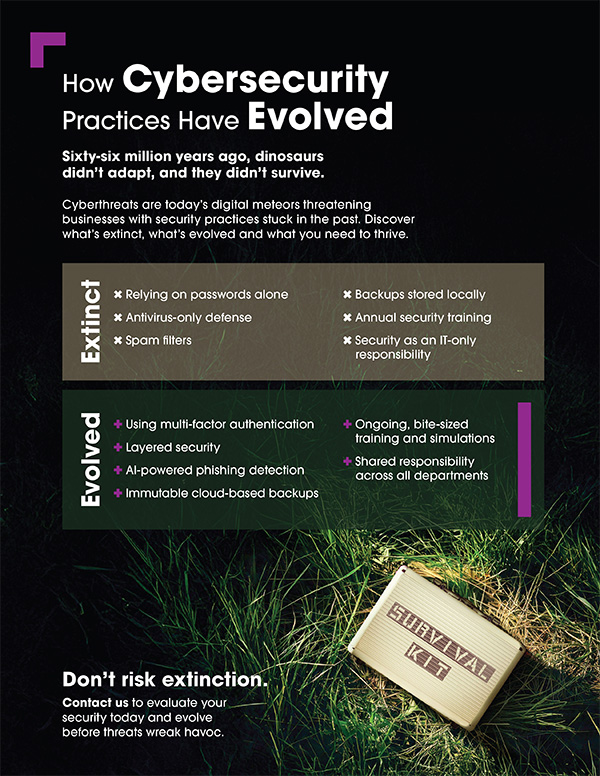
 In the natural world, survival belongs to those who adapt. The same principle applies to the digital business environment, where cyberthreats represent constant pressure for organizational change and improvement. Businesses that maintain outdated security practices face potential elimination from their market ecosystem.
The message is clear: cyber survival favors the updated. Organizations that embrace modern security practices and maintain adaptive strategies position themselves not just to survive but to thrive in an increasingly dangerous digital landscape.
The Adaptation Imperative
The business environment has fundamentally changed. Cyberthreats no longer represent occasional disruptions—they're constant pressures that test organizational resilience daily. Consider the research: according to a University of Maryland Clark School study, businesses experience cyberattacks every 39 seconds on average, and IBM's Cost of a Data Breach Report shows the global average cost reached $4.88 million in 2024.
Updated organizations demonstrate key characteristics:
- Proactive security postures that anticipate rather than react to threats
- Continuous improvement processes that refine security measures based on new intelligence
- Integrated security cultures where every team member contributes to organizational defense
- Resilient infrastructure designed to maintain operations during security incidents
Essential Modern Security Practices
Multi-Layered Defense Systems
Modern cybersecurity requires multiple defensive layers that work together. When one layer faces compromise, others maintain protection. This includes endpoint detection and response, network monitoring, application security, email filtering, and user behavior analytics.
Zero-Trust Security Models
Updated businesses implement zero-trust architectures that verify every user and device before granting access to systems or data. This approach assumes that threats can originate from anywhere and requires continuous verification.
AI-Enhanced Threat Detection
Artificial intelligence and machine learning enable organizations to identify threats that traditional security tools miss. These systems analyze patterns, detect anomalies, and respond to threats at machine speed.
Cloud-First Security Strategies
Modern businesses embrace cloud technologies while implementing appropriate security controls, including understanding shared responsibility models and maintaining visibility across hybrid environments.
Continuous Security Training
Updated organizations provide ongoing security awareness education that adapts to emerging threats. This continuous reinforcement keeps security awareness current and actionable.
The Cost of Failing to Adapt
Organizations that resist security adaptation face predictable consequences:
- Operational Disruption: Successful attacks interrupt business operations
- Financial Impact: Direct costs for recovery, regulatory fines, and lost business
- Reputation Damage: Security failures undermine client confidence
- Regulatory Consequences: Compliance violations and penalties
- Competitive Disadvantage: Loss of opportunities to security-conscious clients
Industry-Specific Adaptation Strategies
Healthcare Organizations must balance security requirements with patient care needs, implementing protections that maintain HIPAA compliance while supporting clinical workflows.
Financial Services require security measures that protect customer financial data while maintaining transaction processing speed and reliability.
Legal Firms need security that preserves attorney-client privilege while enabling collaborative case work and client communication.
Municipal Governments must protect citizen data and critical infrastructure while maintaining public service accessibility.
Nonprofit Organizations require cost-effective security solutions that protect donor information and operational data without straining limited budgets.
Ready to Ensure Your Survival?
The digital environment will continue presenting new challenges and threats. Organizations that embrace adaptation as a core competency will not only survive but gain competitive advantages through their resilience and reliability.
Heritage Digital specializes in helping organizations navigate security adaptation with practical, effective strategies tailored to specific business needs and industry requirements.
Our adaptation support includes comprehensive security assessments, strategic adaptation planning, phased implementation support, ongoing monitoring and optimization, and industry-specific expertise for healthcare, financial services, legal, municipal, and nonprofit sectors.
Through our "Your IT: Simplified and Secured" mission, we transform complex security challenges into practical adaptation strategies that strengthen your business resilience.
Ready to adapt and thrive?
Contact Heritage Digital at 843-699-1001 or schedule a consultation. We'll assess your current security posture and develop a strategic adaptation plan that ensures your survival and success in the digital landscape.
Remember: in cybersecurity, survival favors those who adapt. Make sure your organization is ready for whatever challenges lie ahead.
DOWNLOAD THE CYBERSECURITY TIP SHEET NOW
About the Author

Marty Parker
Owner & CEO
Marty is the Owner & CEO of Heritage Digital. With over 30 years of experience in building and leading top-notch IT teams, Marty has a rich background in both the manufacturing and healthcare sectors. He spent 13 years in each industry before taking the helm at Heritage Digital. Before leading Heritage Digital, he served as the CIO of Carolinas Hospital System (now MUSC Health Florence Medical Center). Marty is dedicated to educating and safeguarding people from cyber threats.